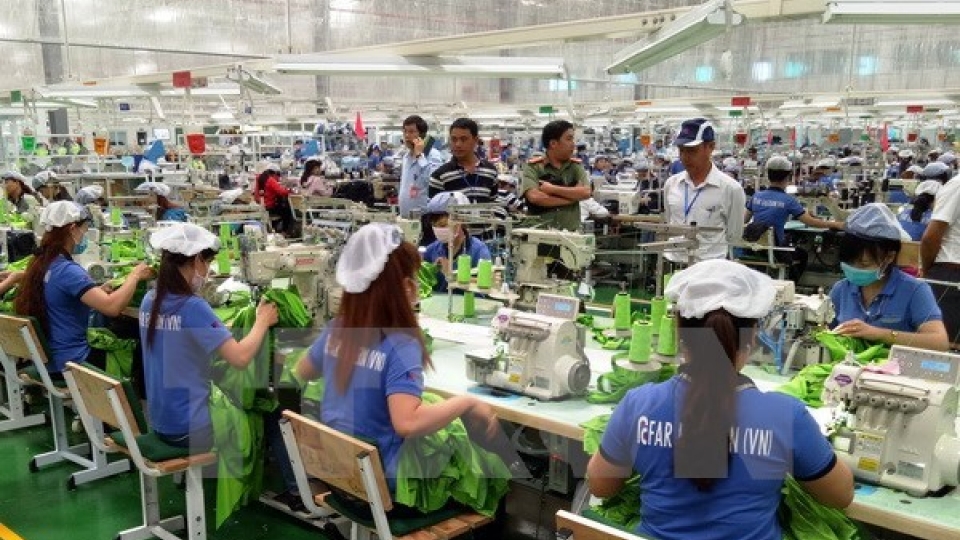
A phone charging cable production line of the KSD Vina Co. Ltd, invested by the Republic of Korea, in Thai Nguyen province |
Minister of Planning and Investment Nguyen Chi Dung said the FDI sector contributes about 25% to social investment capital and 20% to the gross domestic product (GDP).
Close to 58% of total FDI capital has went to the processing and manufacturing industries, helping Vietnam increase the value of products and create a shift in domestic economic sectors in a more positive and competitive way.
In 2017, the FDI sector made up 72% of total export value and generated about 3.5 million direct jobs and 5 million indirect employments.
FIA Director Do Nhat Hoang said FDI has flown into all 63 cities and provinces nationwide. The southern largest economic hub of Ho Chi Minh City tops the list with US$44.7 billion in registered FDI, accounting for 13.8% of the total investment.
The southern province of Binh Duong ranks second with US$30.7 billion, accounting for 9.5% of the total investment, followed by the capital city of Hanoi and Dong Nai province with US$27.7 billion and US$27.34 billion, respectively.
The Ministry of Planning and Investment is drafting a strategy to draw FDI in 2018-2023 with the assistance of the World Bank (WB).
Economists suggested Vietnam change its FDI attraction policies, focusing on high-quality projects applying new cutting-edge technologies, having strong influence on the economy and supporting domestic business development.
WB experts advised the country to draw FDI based on technology, labour skills and production value chains.
Vice Chairman of the People’s Committee of Vinh Phuc province Le Duy Thanh said there should be mandatory policies for foreign businesses while investing in Vietnam such as requiring them to ensure a localisation rate of 60% instead of 10% at present.
Vietnam remained an attractive destination for foreign investors in 2017 with total registered FDI capital hitting a record high of US$35.88 billion, up 44.4% against last year.
The most attractive sectors were manufacturing-processing industries, electricity production and distribution and real estate.
Among 115 countries and territories investing in Vietnam in 2017, Japan topped the list, with US$9.11 billion, making up 25.4% of total amount.
It was followed by the Republic of Korea with US$8.49 billion or 23.7% of the FDI, and Singapore with US$5.3 billion or 14.8%.